







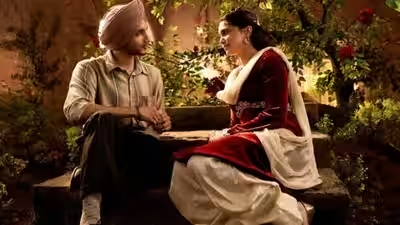
Imtiaz Ali‘s coming-of-age drama Main Vaapas Aaunga has won critical acclaim for its sensitive depiction of Partition and the possibility of reconciliation. At the heart of the story is 95-year-old Ishwar (Nasiruddin Shah), he wanted to revisit his hometown of Sargodha (in present-day Pakistan), a decision that made his family, especially his grandson Nirvair (Diljit Dosanjh),Puzzled. As the film continues to resonate with audiences, co-writer Nayanika Mahtani reflects on its deeply personal roots and the ideas that shaped its narrative.Nayanika recalls how her collaboration with Imtiaz Ali started unexpectedly in Mussoorie. She happened to meet the filmmaker there and gave him a copy of her novel “Crossing the Line,” which also explores Partition. Coincidentally, Imtiaz was writing a story around the same historical event and was asked to write 20 to 30 pages on the subject. After reading her work, he simply told her: “Let’s move on.”This opportunity was particularly meaningful for Nayanika as she wanted to tell a Partition story without the divisive narrative. “Of course, I was excited to tell a Partition story, but also because of the sensitivity that Imtiaz brought to it, because I was very clear that I didn’t want to tell a story where there was an ‘other’ or an ‘otherness’. I would rather not tell a story than tell a story like this,” she said.For the writer, Main Vaapas Aaunga also has its own family history. All four of her grandparents immigrated from what is now Pakistan, and her maternal grandmother was from Sargodha, the same town at the center of the film. Recalling the memories of her grandmother, Nayanika said, “Whenever my Nani talked about Sargodha, she only talked about happy memories. There was never pain. There was never resentment. Imagine how many reasons there were for her to feel pain.“She said her grandparents from Lahore and Rawalpindi had similar memories. What they remember is not resentment but friendship that transcends religion. “Their best friends are still Muslims. I have never seen an ounce of hatred in that generation. So when we told the story, even Imtiaz felt the same way, no one else,” she added.Nayanika agrees that the emotional trauma endured by many who lived through Partition remains largely unspoken. Talking about Ishvar’s role in the film, she explained: “Ishar Grewal is not a good person. He is a bitter man. But look what he went through. That’s where it ends, because we just judge them based on what we see, but there are things they don’t talk about. “Elaborating on the idea, she said: “There are things that are never talked about. Many of them suffer from post-traumatic stress disorder. But no one talks about it because independence coincided with the partition and that took center stage. So, you were not allowed to be unhappy. But imagine what they would think every year on the eve of independence. “Nayanika further revealed that she and Imtiaz Ali were determined to portray the suffering experienced on both sides of the border rather than present a one-sided narrative. “Imtiaz and I were both sure of one thing. I told him, ‘We have to have a scene where we see Muslims being killed.’ So, the scene on the train where Keanu’s hat falls off, and the scene when the train arrives at the Lahore station where Afzal discovers that his entire family is dead. So, we see both sides and have a balanced view. Otherwise, it could become anger bait,” she argued.