









Taylor Swift has won a court ruling dismissing a copyright lawsuit brought by poet Kimberly Marasco, who accused Taylor Swift of plagiarizing lyrics from her poetry in multiple albums. Judge Erin Cannon granted the motion Monday, finding Marasco’s claims lacked merit.According to the lawsuit filed by Marasco in February 2025, Marasco accused Swift of plagiarizing lyrics from more than a dozen songs from her albums “Lover,” “Folklore,” “Evermore,” “Midnights” and “The Tortured Poets Department.” The poet’s complaint includes allegations of copyright infringement on multiple albums from Swift’s discography over the years. According to Global News, which obtained the order dismissing the motion, the judge’s ruling determined that the works shared only “basic ideas and themes,” such as women working in corporate settings, being subject to “gaslighting” and facing adversity.
The judge’s reasons for rejecting
In her ruling, the judge concluded that these types of concepts do not fall within the scope of copyright protection. “These are quintessential themes, concepts, and isolated words—exactly the kind of material that copyright law does not protect,” Cannon wrote in the order.The judge pointed to other commonalities between the works that did not constitute copyright infringement. Other basic concepts, the order states, include “ubiquitous metaphors (‘drowning’ under water, ‘tears as weapons’, ‘desire as fuel and fire’, becoming ‘rain/storm’); and isolated common words and phrases (‘tears’, ‘run’, ‘fire’, ‘rain’, ‘sky’, ‘love’, ‘unseen’, ‘shut me in the flesh'”).“Cannon hardened her stance on copyright law protections. “The allegedly infringing material—underlying ideas, themes, metaphors, isolated words and phrases—is not protected expression and cannot be infringed,” she wrote.

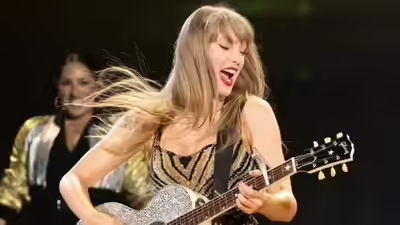
The court held that the alleged overlap between Marasco’s poem and Swift’s lyrics did not qualify for copyright protection. Image source (Taylor Swift Instagram)
Comprehensive analysis of the court
The judge’s ruling addressed both the nature of the allegedly copied material and Marasco’s inability to prove the copying. “The Court concluded that Plaintiff’s poetry did not contain a protected expression and, in any event, Plaintiff failed to reasonably plead plagiarism. “On these independent grounds, dismissal of the case is warranted and the court is not required to consider the defendants’ remaining arguments,” Cannon wrote.The judge also noted that Marasco had multiple opportunities to amend her complaint but failed to strengthen her case. “Plaintiff had an ample opportunity to defend her claims; she was expressly warned that the second amended indictment would be her last chance and further amendments would be futile,” the judge said, adding that no further amendments would be allowed.
Related trademark litigation
In addition to the copyright case, Swift faces other legal challenges. She was also recently sued by a Las Vegas performer claiming her latest album infringed on trademark rights. The performer claimed in the complaint that marketing for Swift’s album could “overwhelm” her long-running stage show and asked the court to prevent confusion between Swift and her album’s title.Swift’s attorneys asked the court in May to dismiss the trademark infringement lawsuit, characterizing the case as “Plaintiff’s latest attempt to generate publicity by contacting Ms. Swift,” according to the defendants’ notice of motion and motion to dismiss.The ruling marks another legal victory for Swift, whose latest studio album, “The Tortured Poets Department,” remains one of the biggest commercial successes of her career.