









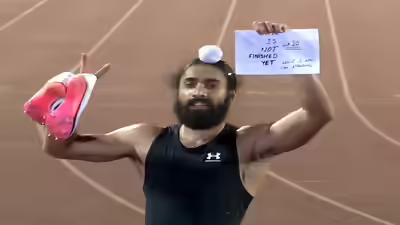

New Delhi: A carefully preserved Rs 500 note tucked inside the back cover of his mobile phone bears witness to every step of sprinter Gurindervir Singh’s extraordinary journey. The folded note, which the national record holder calls his “lucky charm”, is a reminder of those struggling days when he found it difficult to fund his training and once practiced in Punjab without enough money to pay for travel.“Someone helped me when I needed it the most. That note has been with me ever since,” Gurindervir said, declining to reveal the full story. “The full story is my biopic.”Now, the 25-year-old Indian Navy sprinter has a bigger story to tell. At the Fed Cup in Ranchi late last month, Gurindervir became the first Indian to break the 10.10-second barrier in the men’s 100m race, setting a national record of 10.09 seconds. He believes that this achievement is just a milestone.“My goal is not to stop at 10.09. If I remain stable, maintain good training, recover properly and follow the process, I believe it is possible to achieve sub-10 results in future competitions.” Gurindervir said confidently.Gurindervir transformed his training and mindset under coach James Hillier at Reliance Foundation. Every aspect of his preparation—strength, speed, flexibility, recovery, diet and game execution—is meticulously planned. “Before I had to handle everything alone. Now I have the support of coaches, physiotherapists and nutritionists. We plan every phase of training, from strength to speed, and the results follow,” he said.European training begins in Spara, Poland, in July, with key targets including the upcoming Commonwealth Games and Asian GamesGurindervir’s next goal is clear. “I have passed the 10.10 level. Now, I am pursuing a bigger goal – becoming the first Indian to run under 10,” he said.A big reason for Gurindervir’s breakthrough was a deeper understanding of the structure of his game. “I’ve always had a good start, but early on I struggled to maintain speed in the last 30 meters. This year, we worked extensively on improving my acceleration, race angle, block and foot strike. My race pattern is simple – accelerate through the first 30 meters, work towards top speed for about 60 to 65 meters, and then maintain it to the finish,” he said.His favorite fitness exercises are squats and hangs. He lifted 220kg in the half squat and 145kg in the hang lift, figures that underline the power of India’s fastest sprinter. “I maintain my body fat percentage around 6 to 7 percent during training and then drop it down to 5 to 6 percent during competition,” he added.However, the road to success is not easy. Gurindervir battled severe gut-related health issues caused by poor diet and contaminated water while staying at a sports hotel in Punjab between 2021 and 2023. Due to limited financial resources, he often survives on meatless chicken juice after training.“We didn’t always get the right food. Sometimes we only had gravy with our meals. Sometimes there wasn’t even gravy. The drinking water was poor and all these factors ended up taking a toll on my health,” he said.The condition became so severe that in a little over a week he lost nearly 12 kilograms and had difficulty absorbing nutrients. His sprint career seemed to be in jeopardy. Hillier’s treatment, structured nutrition plan and scientific support helped him rebuild his body and become stronger.Equally important is his psychological evolution. Gurinderville admits that a year ago, he was often overwhelmed by the sudden fame and media attention. “If you met Gurindervir last year, he would have felt a lot of pressure. I was thinking about interviews and expectations. My coach helped me understand how to handle attention and focus on performance. Now I no longer suffer from unnecessary stress. I’m a stress-free person,” he said.His rivalry with sprinter Animesh Kujul added a new dimension to Indian sprinting. The two exchanged national records three times in 24 hours, with Gurinderville winning in 10.09 seconds.“Off the track, we are friends and often roommates. On the track, we are competitors. It’s healthy competition because we push each other to improve. “Despite growing recognition, Gurinderville’s sacrifice continues. He hasn’t been home for more than a year and is determined to achieve something bigger before celebrating. “My family kept asking me to come home. I told them I wasn’t going to come back empty-handed. I wanted to come back with something special.”