









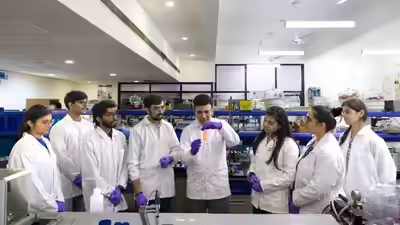
Engineering education is increasingly moving beyond textbooks and laboratories, and institutions are looking for ways to prepare students to meet the demands of a rapidly changing workplace. While internships have long been part of this journey, they often remain short-term experiences outside of the formal academic curriculum.The Indian Institute of Technology Gandhinagar (IIT) is trying something different. Rather than treating industry exposure as an add-on, the college makes it a credit-bearing part of its undergraduate curriculum, allowing BTech students to work with companies, research labs, academic institutions or startups throughout the semester without delaying graduation. The move reflects a growing shift toward integrating real-world learning into engineering education rather than keeping it separate from classroom instruction.A semester of work and studyThe external exposure activity at IIT Gandhinagar was launched in the academic year 2025-26 and will be available as an elective course for seventh-semester BTech students. Through the course module IN 498 – External Exposure, students can earn up to 16 credits through a semester-long collaboration with an approved organization.This makes the program stand out from traditional internships. Instead of summer assignments, students spend nearly the entire semester completing on-site projects while staying on track academically. Their work is jointly evaluated by the sponsoring organization and faculty through regular reviews to ensure that professional experience meets academic standards.The institute said the program’s flexibility also allows students to choose opportunities that match their interests – whether that’s industry, research, entrepreneurship or higher education.Industry, research and start-ups under one academic umbrellaSo far, 18 students have participated in the program, working with organizations such as Qualcomm, Samsung R&D, Oracle, Tower Research Capital, Solar Defense and Aerospace Limited, Caltech and the Indian Institute of Science, Bangalore. Others gained experience in startups such as HapiHygi Innovations Pvt. Ltd.The model is designed to expose students to workplace culture, multidisciplinary collaboration and real-world engineering challenges before graduation, the institute said. It is also aligned with the National Education Policy (NEP) 2020, which encourages experiential learning and enhanced industry-academia collaboration.Bhoumik Patidar, a BTech Computer Science student, shared his experience with external contacts at Qualcomm on an open source software project involving the ELF connector. He said the experience enhanced his problem-solving skills and deepened his interest in systems programming.Likewise, electrical engineering student Tejas Zunjare works in embedded systems, circuit design and hardware development at HapiHygi Innovations. He said the opportunity helped him understand how classroom concepts translate to solving real engineering problems.Changes in Engineering Teaching MethodsWhat is unique about IIT Gandhinagar’s approach is the formal recognition of workplace learning as part of the degree itself. Rather than expecting students to balance internships with academic commitments, the college creates a structured pathway where professional exposure has the same academic value as classroom learning.As engineering careers increasingly require real-world problem solving, collaboration, and innovation, these models can inform our understanding of how technical education may evolve. By giving students the flexibility to choose between traditional classroom study and a semester of immersive external engagement, IIT Gandhinagar is reimagining what it means to prepare graduates for the jobs of the future.