










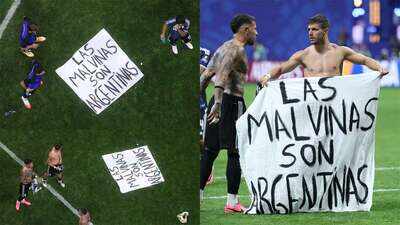
NEW DELHI: Argentina’s dramatic 2-1 comeback victory over England in the 2026 World Cup semi-finals has sparked fresh controversy. Argentine midfielder Giovanni Lo Celso celebrated after the final whistle at Atlanta’s Mercedes-Benz Stadium holding a banner that read “Argentinian Son of Las Malvinas,” a slogan linked to Argentina’s claim to the Falkland Islands.According to The Athletic, such a display could result in disciplinary action from FIFA, as football’s governing body prohibits political messages during matches. Here’s everything you need to know about the controversy:
What does “Argentinian son of Las Malvinas” mean?
“Las Malvinas son Argentinas” translates to “The Malvinas Islands are Argentineans.” “Las Malvinas” is Argentina’s name for the Falkland Islands, a British overseas territory about 300 miles (480 kilometers) off the east coast of Argentina.Lo Celso raised the flag alongside defender Nicolas Otamendi after Argentina’s semi-final win. The banner appears to have been first displayed by supporters in the stands. The pair briefly raised it and then put it away before Lo Celso placed it on the pitch during the celebrations.
Why is the Falkland Islands controversial?
The Falkland Islands have been at the center of a sovereignty dispute between Argentina and the United Kingdom for more than 190 years.The dispute dates back to the early 19th century during the Napoleonic Wars. Britain first claimed sovereignty over the islands in 1774 and regained control in 1832.In 1982, the Argentine military government invaded the islands in an attempt to seize control, triggering the Falklands War.The conflict lasted from April 2 to June 14 and ended with Argentina’s surrender. Three civilians, 255 British servicemen and 649 Argentinian soldiers died during the war.
What does the Argentine Ministry of Foreign Affairs say?
Days before the World Cup semifinals, Argentina’s Ministry of Foreign Affairs issued an official communiqué reaffirming the country’s claim to the islands.The title of the statement is:official communicationMalvinas issue: The Argentine Republic lodges a protest with the UK over the unannounced movement of HMS Medway towards the coast of mainland ArgentinaIn accordance with the instructions of Minister of Foreign Affairs Kilno, a formal note of protest was submitted to the Embassy of the United Kingdom of Great Britain and Northern Ireland on July 13, expressing the strongest rejection of the actions of the Medway warship illegally stationed in the Malvinas Islands, which were not notified in time in accordance with existing bilateral agreements and declarations, and involved transit through Argentine territorial waters.This unilateral action violates the commitments made by the two Governments in the Joint Declaration of September 25, 1991 (replacing its Annexes I, II, III and IV) and the Joint Declaration signed in Madrid on February 15, 1990, of which Section I.2 “Strengthening of the 192The Argentine government firmly opposes the British military invasion of areas under Argentine jurisdiction, which is a continued policy of unilateral behavior that is inconsistent with United Nations resolutions and the obligations of both parties not to change the situation while the sovereignty dispute is pending.This unannounced and illegal action violates the bilateral commitments between the two countries on confidence-building measures in the military field, while exacerbating a series of unilateral actions taken by the United Kingdom of Great Britain and Northern Ireland in violation of United Nations General Assembly resolution 31/49, which urges both parties not to make decisions that would require unilateral changes in the situation in the Malvinas Islands while the sovereignty dispute remains unresolved.Far from creating the conditions of trust and understanding required for a mature bilateral relationship, these actions have deepened tensions in the South Atlantic, ignored repeated mandates from the international community, and hindered Argentina’s efforts to promote a peaceful settlement of disputes through negotiation.The Argentine Republic once again reaffirms its legal and unimpeded sovereign rights over the Malvinas Islands, South Georgia Islands, the South Sandwich Islands and their surrounding waters.By history, by rights and by belief, the Malvinas Islands belong to Argentina.Ministry of Foreign Affairs
Why should FIFA take action?
The International Football Association Board (IFAB) and FIFA prohibit the use of political slogans, symbols and messages during matches.IFAB’s rules of the game state: “Equipment must not contain any political, religious or personal slogans, statements or images. Players may not reveal underwear with political, religious, personal slogans, statements or images, or advertising other than the manufacturer’s logo. “It added: “For any infringement, players and/or teams will be subject to sanctions by the tournament organizers, national football associations or FIFA.”Argentina could also be in breach of the governing body’s stadium code of conduct if FIFA deems the “Argentina, son of Las Malvinas” banner to be political.FIFA’s list of prohibited items includes: “Any material of a political, offensive and/or discriminatory nature, including but not limited to banners, flags, leaflets, clothing and other paraphernalia, containing any form of discrimination against a country, an individual or otherwise on the basis of race, colour, national, ethnic or social origin, gender identity and expression, disability, language, religion, political opinion or any other opinion, birth, wealth or any other sexual orientation or otherwise.“